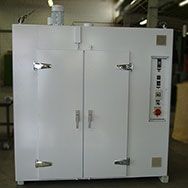
Annealing is not an oven type
Many inquiries begin with the word tempering oven. Technically this is understandable, but inaccurate. Annealing describes the heat process: A workpiece, component, granulate, tool or material is brought to a defined temperature and held there for a specific time. The right oven for this does not depend on the term, but on the application.
For the design, the process data is first clarified. This results in the appropriate type of oven: circulating air oven, heating chamber, continuous oven, chest oven, laboratory dryer or special system.
First clarify process data. Then choose the oven type. This is exactly what creates a system that functions reproducibly during operation.
Purchasing criteria for tempering processes
A tempering process is not decided by a single temperature specification. The decisive factor is the combination of target temperature, holding time, heating behaviour, component mass, air flow, safety and integration into production.
Which type of oven is suitable?
| Furnace type | Suitable for | Crucial point |
|---|---|---|
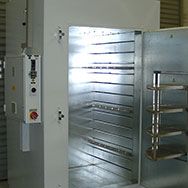
| Convection/fresh air oven | Batch processes, plastic and rubber molded parts, half parts, tools, molds, granules, spinning pumps and nozzle packages. | Uniform flow through the batch and reproducible temperature control. |
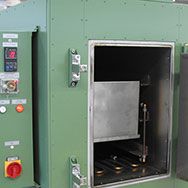
| Heat chamber | Electronics, semiconductors, wafers, assemblies, sensitive materials and processes with a defined atmosphere. | Process space, atmosphere, documentation and control must be considered together. |
| Continuous oven | Continuous parts, film strips, assemblies, damper components and cycle-related manufacturing processes. | Dwell time, conveyor technology, inlet/outlet and interface to the line determine the design. |
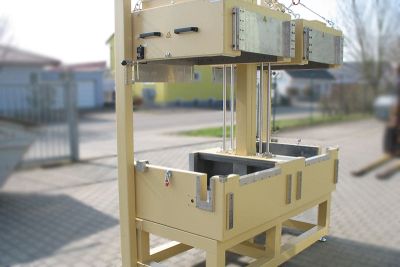
| Chest oven / shuttle oven | Large batches, heavy components, tools, molds or processes with special handling. | Loading, usable space, load capacity, removal and operability are crucial to the process. |
| Laboratory dryer | Research, development, medicine, microbiology, chemistry, energy, refining and environmental catalysis. | Small batches, precise tests, clean documentation and reproducible laboratory conditions. |
| Special facility | If standard dimensions, air flow, atmosphere, cycle, temperature profile or loading do not fit. | Joint planning with specialist departments, control, safety and interfaces to production. |
Batch or run?
Batch processes fit when batches are tempered collectively, when components lie on sheets, drawers, trolleys or racks or when the process time is not directly linked to a running line. Convection ovens, heating chambers, chest ovens, shuttle ovens and laboratory dryers are typical.
Continuous processes fit when components or foils run continuously, when cycle times and dwell times correspond exactly or when the oven is part of a production line. Then conveyor technology, deflection rollers, inlet and outlet areas, sensors and controls become particularly important.
Typical tempering applications
When will it become a special solution?
A special solution is not automatically more expensive, but is technically cleaner if the standard does not reflect the process requirements. This applies, for example, to large usable spaces, heavy loads, special air flow, regulated fresh air, inert gas, processes requiring documentation, customer-side controls or confined spaces.
- The temperature profile, holding time and cooling behaviour are fixed.
- The batch must be kept evenly tempered across multiple levels or racks.
- Atmosphere, exhaust air, safety or EX issues must be technically checked.
- The system should be integrated into a customer-side control system.
- Old systems need spare parts, modernization or a process-related successor solution.
What we need for the design
A few details are often enough for a reliable technical assessment. The more precise the process data, the faster it is possible to identify which type of furnace makes sense and which points still need to be checked.
- Material, component or medium that is to be tempered.
- Target temperature, starting temperature, holding time and desired heating time.
- Component dimensions, batch weight, number of pieces, cycle and loading.
- Desired temperature distribution or quality requirement.
- Atmosphere, exhaust air, humidity, solvents or safety-related conditions.
- Control, interfaces, documentation, available space and loading.
Clarify the tempering process technically
Send us the target temperature, material, component dimensions, batch weight, holding time, cycle, atmosphere and installation situation. We check which type of furnace makes technical sense.