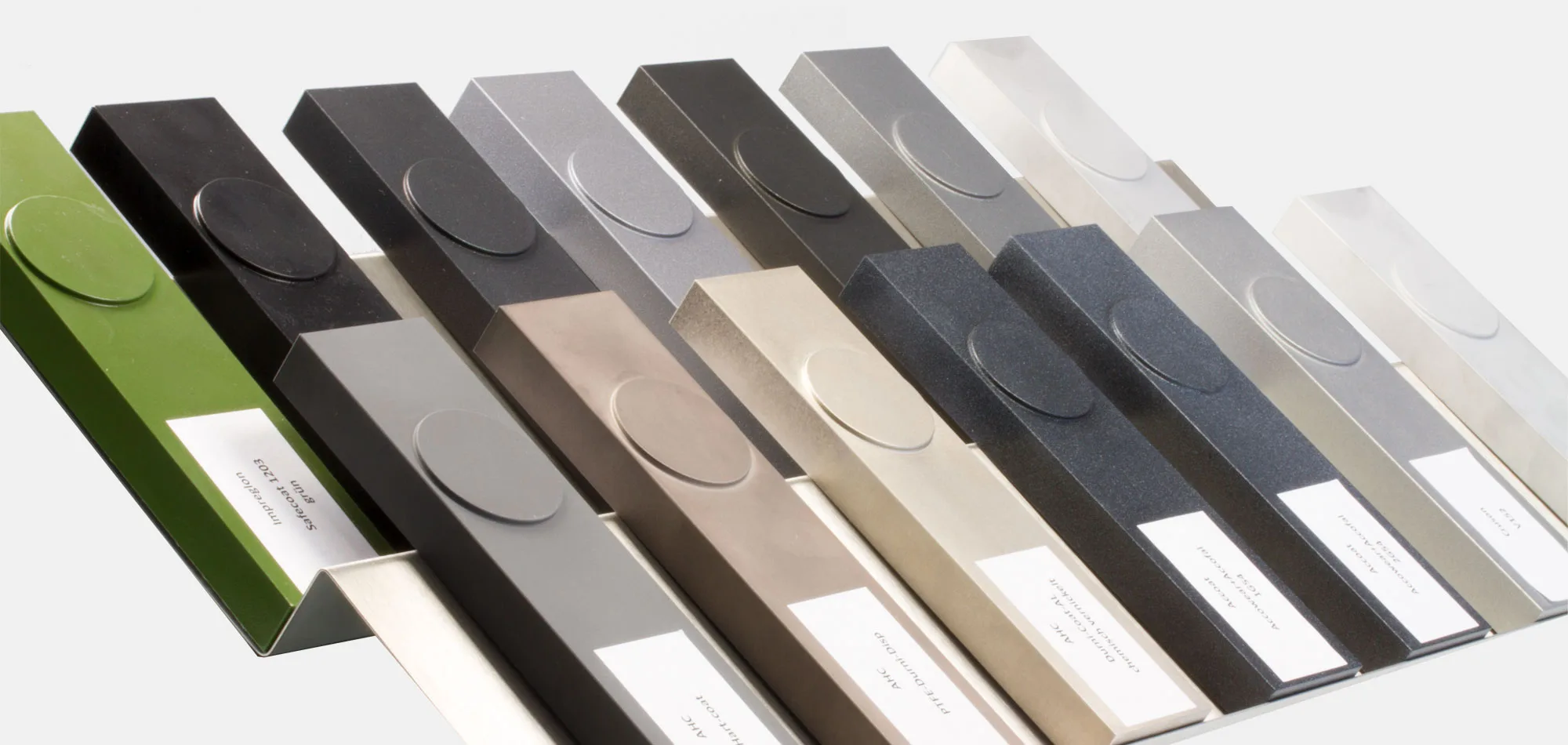
01 — BasicsWhy PTFE on sealing plates?
During heat sealing, a heated plate presses foils or composite materials together under pressure and temperature. The problem: Melted plastic sticks to bare metal. A PTFE non-stick layer solves exactly that: clean release, even seams and a stable cycle without film residue sticking on.
PTFE (polytetrafluoroethylene) is ideal for this because it combines three properties that hardly any other material offers at the same time: one extremely low surface energy (nothing clings to), one high temperature resistance and one almost universal chemical inertness. On a cast aluminium radiator, this combines the good heat distribution of the metal with the non-stick effect of the coating.
02 — Layer structureWhat lies on the metal
An industrial PTFE coating is rarely a single layer. A multi-layer structure is typical, in which each layer has a task. From bottom to top:
PTFE top layer (topcoat)
The actual non-stick and sliding surface. Provides friction coefficient, release behaviour and chemical resistance.
Primer / adhesion promoter
Anchors the coating to the metal. Without it, PTFE – which by definition has poor adhesion – would not hold. Key for downtime
Pretreated aluminium
Roughened or anodized (hard anodized) so that the primer grips mechanically and chemically. Some systems store PTFE directly in the anodized layer.
Cast iron radiator/support plate
Brings and distributes the heat. The coating is only as evenly effective as the body heats evenly.
PTFE is applied as a dispersion or powder and then baked or sintered at high temperatures, not injection molded. Depending on the system, layer thicknesses are typically in the range of a few to a few dozen micrometers; In anodized composite systems, the anodized and PTFE components come together. The specific values are stated in the data sheet of the respective coater.
03 — Temperature limits327°C melts, but 260°C is the limit
Here lies the most important and most misunderstood detail. PTFE has one Melting point of about 327 °C – but that is not an operating temperature. The useful properties (strength, dimensional stability) diminish long beforehand.
The practically relevant limit is this Continuous use temperature of around 260 °C. Until then, PTFE reliably retains its non-stick, sliding and chemical properties. Short-term peaks above this are possible depending on the type, but should not become the rule. Above 260 °C the material begins to degrade; Significant overheating, especially above around 350 °C, can produce decomposition products that are harmful to health.
Safety note: If PTFE is severely overheated or burned locally dry, fluoropolymer decomposition products can be released. In practice this means: temperature limitation, control, sensor position and ventilation are part of the technical design for coated sealing tools.
PTFE is practically unlimited in terms of its downward range: the continuous use range extends to around −200 °C, and the material does not become brittle even in extreme cold. This is rarely relevant for sealing applications, but it illustrates the thermal robustness of the layer.
04 — CharacteristicsPTFE in numbers
Guide values for unfilled PTFE. They classify the material behaviour - the data sheet is always binding for a specific coating system.
| Characteristic | Guideline | Importance for sealing plates |
|---|---|---|
| Melting temperature | ~327°C | Phase transition, no operating limit |
| Continuous use (top) | ~260°C | Practical upper limit for sealing operations |
| Continuous use (bottom) | ~−200 °C | Cold-resistant, does not become brittle |
| Friction coefficient (dyn., against steel, dry) | 0,05–0,2 | Very low; depending on the opposing partner, load, speed and surface. |
| Thermal conductivity | ~0.25 W/(m K) | Low, the layer insulates slightly. So keep it thin. |
| Water absorption | <0.01% | Practically none – dimensionally stable, hygienic |
| Burning behaviour | incombustible | Safety advantage in heated tools |
An important design note is the low thermal conductivity: PTFE insulates. A layer that is too thick slows down the heat transfer from the plate to the sealing seam. Therefore, the layer should be as thin as possible and as thick as necessary: enough for wear reserve and non-stick, no more. The coefficient of friction is also not a fixed catalog value; it is shifted with test setup, surface pressure, speed and surface condition.
The opponent: the carrier body
While PTFE deliberately conducts heat poorly, the body beneath it should distribute it as well as possible. Typical cast materials for coated heating plates and their characteristics:
| Cast material | Thermal conductivity | Operating temperature* |
|---|---|---|
| AlSi8Cu3 (aluminium) | 110–130 W/(m K) | ≤ 450°C |
| AlSi7Mg0.3 (aluminium) | 160-170 W/(m K) | ≤ 450°C |
| CuZn39Pb (brass) | 65–85 W/(m K) | ≤ 650°C |
*Characteristics of the cast body without coating. The PTFE coating limits the surface temperature during sealing operation to around 260 °C. The cast body itself can withstand significantly more, which creates reserves for heat conduction and geometry. tubular heaters made of stainless steel (1.4541 or 1.4828) are cast in.
05 — Two waysCoated board or PTFE glass fabric?
In practice, two solutions compete to prevent sticking: the PTFE coating applied directly to the tool - and a replaceable PTFE-coated glass fabric (tape) over the sealing jaw. Both have clear strengths.
Integrated & even
- Best heat transfer, no additional separating layer
- No consumables, no tape changes at the same time
- Even, precisely contoured surface
- In case of wear: Re-coating necessary (more complex)
- Ideal for constant, long-running tasks
Protective & replaceable
- Can be changed quickly and cheaply in case of wear
- Protects the heating element from film build-up
- Flexible with frequently changing materials
- Additional thermal layer, therefore a little more heating power or time required
- Ideal for changing tasks and short set-up times
06 — Manufacturing depthWhy manufacturing makes the difference
A cast radiator with a cast-in heating conductor and a precisely fitting non-stick layer is not a catalog item that can be purchased at will. It only arises where foundry, heating element production, mechanical processing and testing come together under one roof.
This is exactly where Ihne & Tesch comes in: We manufacture cast iron heaters ourselves at the Lampertheim location own foundry (chill and sand casting, four casting furnaces with a total volume of over 1000 liters) and a machine park of over 12 CNC machining centers for precise further processing after casting. From design to casting and CNC machining to testing, technical responsibility remains in-house. This depth of production is the prerequisite for precisely matching geometry, heat distribution and layer systems instead of just combining components.
The difference is often not visible in the finished image. A coated radiator looks similar everywhere on a product page. What matters is what lies behind it: whether the component is actually cast, processed, coated and tested in-house or just shown. Resellers show product photos; a manufacturer shows vertical integration, foundry, machinery, process and responsibility. This makes Ihne & Tesch one of the leading OEM suppliers in Europe for cast heating elements, especially for PTFE-coated heating plates with complex contours in molding, sealing and packaging processes.
07 — SelectionFind the right solution in five questions
From practiceHeated sealing tools from a single source
A non-stick layer only works on an evenly heated body. We manufacture the necessary heating and control technology in-house - from the cast iron radiator to the precise temperature control to the sensors that keep the sealing temperature safely below the critical limit.
Frequently asked questions
Up to what temperature can a PTFE coating be used?
The upper continuous use temperature of PTFE is around 260 °C. Higher temperatures are possible for a short time, but as the material approaches its melting point of around 327 °C, the useful properties decrease significantly. Significant overheating, especially above around 350 °C, can produce decomposition products that are harmful to health. For continuous operation, 260 °C is the guideline value; the specific value depends on the coating system and the mechanical load.
Which is better: coated sealing plate or PTFE glass fabric tape?
Both have their place. The directly coated plate transfers heat more evenly and does not need to be replaced, but is more difficult to repair if worn out. The glass fabric tape can be replaced quickly and cheaply, protects the heating element and is suitable for frequently changing tasks, but forms an additional thermal layer.
Why can't PTFE simply be sprayed on like other plastics?
PTFE has an extremely high melt viscosity above its melting range and practically does not flow. It cannot therefore be injection molded or extruded in the traditional way, but rather is applied as a dispersion or powder and then baked or sintered at high temperatures.
Can a PTFE non-stick layer tolerate food contact?
There are PTFE coating systems with food contact approval (e.g. FDA, H1). The decisive factor is the specific approval of the selected system in the respective application, not the PTFE material class in general.
Why should the PTFE layer be as thin as possible?
PTFE conducts heat poorly (~0.25 W/(m K)). A layer that is too thick insulates and slows down the heat transfer from the plate into the sealing seam. The layer is therefore designed to be as thin as possible and as thick as necessary - sufficient for non-stick effect and wear reserve without unnecessarily hindering the flow of heat.