High-tech on the supermarket shelf
There are products that appear on supermarket shelves every day and yet are rarely perceived as high-tech. This includes the yoghurt cup with an integrated bend for cereals or crunchy muesli. Its function seems simple at first glance, but its quality actually depends heavily on the temperature control in production.
Ihne & Tesch has been producing coated cast aluminium heating plates for demanding applications in form, fill and seal systems, or FFS machines for short, for more than three decades. These components perform a critical function in production: They must distribute heat very evenly so that films can be reliably formed and securely sealed.

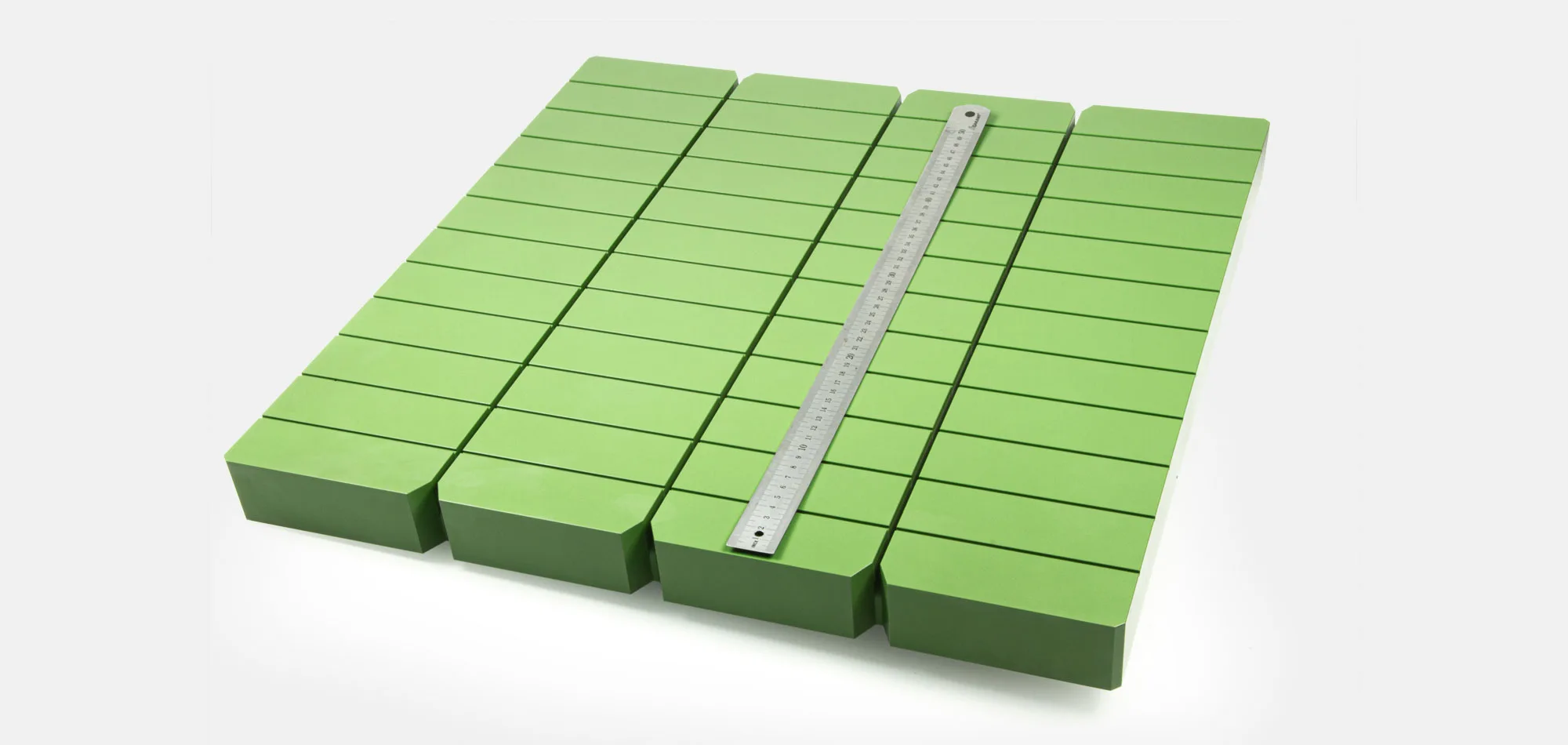
It's not the heating plate alone that decides - but rather the temperature profile in the process.
Why temperature homogeneity is crucial
In an FFS system, two thermal processes take place directly one after the other: thermoforming the plastic film into the cup and heat sealing the lidding film. Both steps are sensitive to temperature variations, but in different ways.
During thermoforming, the plastic film is brought to a defined temperature and then pulled into the mould using vacuum or compressed air. With a simple round cup, this process is comparatively easy to control. However, with a bent cup with asymmetrical geometry, significantly more complex temperature distributions arise on webs, edges and transitions.
If the heating plate is too cold in these areas, the material will deform unevenly. The result can be thin zones, tensions or cracks. If it is too hot, the material can be damaged locally, which later becomes noticeable in the form of discoloration, weakening or restrictions in the barrier properties.
Heat sealing with high precision
After filling, the lid film is sealed on. Especially in cups with separate chambers, the sealing seam on the sensitive inner webs must be reliably tight. Even small deviations can lead to product components mixing prematurely.
In practice this means: The sealing temperature must be very uniform across the entire surface. Depending on the material, geometry and process requirements, tight tolerances are required. This is exactly where the strength of high-quality cast iron heating plates lies: They ensure a stable temperature profile even in demanding three-shift operation.
Less material, but higher requirements
In the packaging industry, material savings are a key factor for profitability. Even small reductions in film thickness can result in significant savings when extrapolated to large quantities. At the same time, the sensitivity to temperature errors increases with thinner films.
If a heating system does not deliver uniform heat output, the foil often needs to be made thicker to accommodate process fluctuations. This reserve can often be reduced with precisely working cast iron heating plates. This can significantly reduce material costs and make the process more stable.
Why cast iron heating plates are technically convincing
The advantage of cast aluminium heating plates lies in the way they are manufactured. The heating conductors are not only attached or pressed in, but also cast directly into the metal. This creates very good heat transfer without significant air gaps or contact losses.
The result is a uniform surface temperature with good reproducibility. For applications with direct contact with thermoplastics, surface quality is also crucial. PTFE coatings improve non-stick properties and support reliable operation at higher temperatures.
For particularly stressed systems, surface refinements with hard anodization and PTFE incorporation can also be considered. This combination increases wear resistance and at the same time offers good sliding properties compared to films and packaging materials.
OEM original equipment as proof of quality
A strong signal about the quality of a component is not just a technical data sheet, but a food manufacturer's decision to include that component directly in its machine specification. When a producer specifies a heating plate by name, this is a clear indication of trust in process stability and reproducibility.
This position is not created through the lowest price, but rather through experience, application expertise and reliable results in the field. Anyone who knows the economic consequences of temperature deviations not only evaluates the acquisition costs, but also the entire process over the lifespan of the system.
Technical design parameters
- Plate structure and geometryNumber of cavities, web geometry and external dimensions.
- Specific wing loadingTailored to application, temperature profile and service life requirements.
- Zone heatingSeparate control loops for main areas and critical edge or web zones.
- Cooling integrationOptionally with water or air cooling for faster cycle times.
- Connection and protection classVibration-proof design, tailored to industrial use.
- Surface finishingPTFE coating or wear-resistant special version depending on the material and load.
Conclusion
In FFS systems, small temperature differences often determine product quality, rejects and material usage. This is precisely why precise cast iron heating plates are not a standard component, but rather an essential part of process reliability.
Ihne & Tesch stands for many years of experience, high temperature homogeneity and application-oriented production. The real value lies not only in the heating plate itself, but in the fact that it makes the production process more stable, more economical and more robust.
Are you planning an FFS application?
Talk to us about the geometry, temperature profile and design of your customer-specific heating plate.