Short answer
A cast heater must not be specified solely according to the maximum available connected load. What matters is how much heat the component can absorb per unit of time, how effectively heat is transferred and what losses occur. If the control sensor fails, the control system must enter a defined safe state. Independent temperature limiting can provide the second shutdown level.
Maximum power is useful only when the process can physically absorb it and keep it safely under control.
What happened in this case?
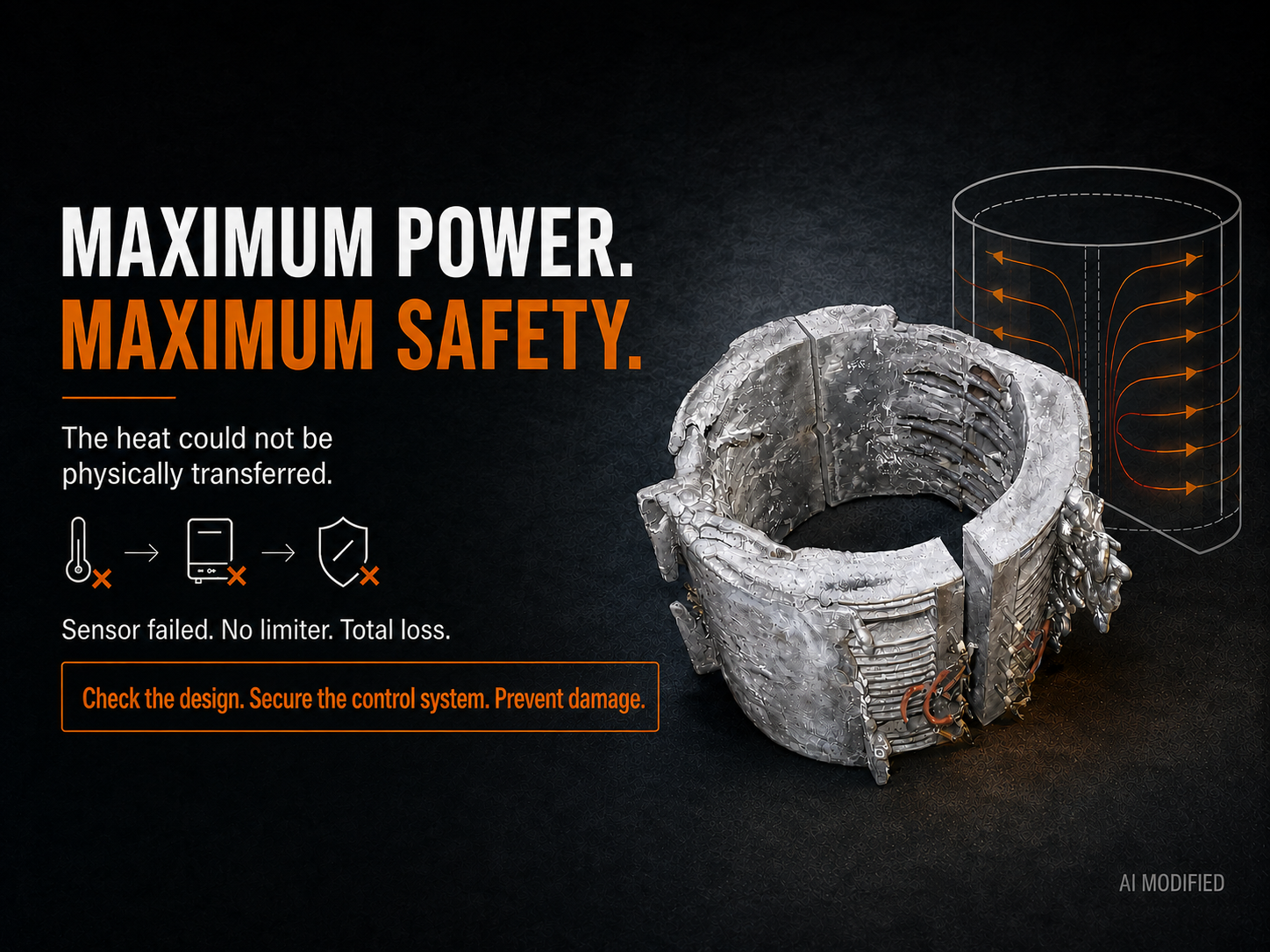
A cast heater enclosed a metal cylinder and was intended to bring it to process temperature. The requirement was for the highest possible heating power, but that figure had not been derived from a complete heat balance of the system.
The control sensor then failed. No independent temperature limiter was fitted. Three risks therefore coincided: high installed power, loss of temperature control and no second shutdown level. The heater remained energised even though the process could not absorb the supplied heat in a controlled manner.
The temperature rose particularly where heat was generated, contact with the cylinder was inadequate or heat could not be dissipated quickly enough. Local excess temperatures damaged the casting, embedded heating conductors and terminal areas.
The physics of correct heating power
For an initial design, the required thermal energy is calculated from mass, specific heat capacity and temperature change:
If this energy is to be supplied within a specified time, the theoretical heating power is:
In practice, heat losses, efficiency, contact conditions, temperature uniformity and permissible component temperatures must also be considered. High electrical power does not automatically mean that the same power reaches the metal cylinder as useful heat.
Watt density and heat transfer
Alongside total power, surface watt density is crucial. It states how much electrical power is converted on the heated area. If heat transfer is limited, the temperature of the heater rises first — not that of the workpiece.
Geometry and material
Casting alloy, wall thickness, conductor position and component geometry determine local heat distribution.
Fit and contact
Air gaps and poor contact surfaces increase the temperature inside the cast heater.
Heating time and target temperature
A rapid setpoint change requires power but must not exceed the permissible load.
Operating mode and losses
Duty cycle, insulation, environment and heat dissipation alter the power that can actually be used.
Why a control sensor alone is not enough
The control sensor supplies the actual value for normal operation. If it fails because of an open circuit, short circuit or implausible reading, the evaluation system must detect the fault and shut the installation down safely.
Temperature controller
Keeps the process temperature within the intended operating range and switches or modulates the heating power.
Temperature limiter
Monitors a permissible maximum temperature and interrupts the energy supply independently of the normal control circuit if a fault occurs.
The implementation of independent limiting depends on the installation, process and risk assessment. The control sensor and limiter must not simply share the same failure-prone measurement or switching chain.
Seven steps to a robust design
Calculate heat demand
Record mass, material, start and target temperatures, heating time and heat losses.
Assess heat transfer
Check the geometry, fit, contact area and installation of the cast heater.
Limit watt density
Match total power to the effective heating area and sustainable thermal load.
Switch power according to demand
Design heating circuits, power stages or modulation for cold starts and steady-state operation.
Position sensors correctly
The measuring point must capture the process-relevant and thermally critical temperature.
Detect sensor faults
Monitor open circuits, short circuits, sudden jumps and implausible readings and handle them safely.
Limit independently
Provide a shutdown separate from the normal control chain in accordance with the risk assessment.
Conclusion
The desire for a short heating time is understandable. Physics, however, cannot be replaced by a larger connected load. A reliable heating system is achieved only when power, heat absorption, heat transfer, control and independent limiting are coordinated.
The decisive question is therefore not: what is the maximum possible power? It is: how much power can the process use safely under all operating conditions?
Frequently asked questions
Can a cast heater have too much power?
Yes. If the workpiece cannot absorb the heat quickly enough, the temperature in the cast heater rises disproportionately. Local overheating can destroy conductors, terminals and the casting.
Why does the normal temperature controller not always provide protection?
If the control sensor, evaluation or part of the switching chain fails, normal control can lose its protective effect. The necessary independent temperature limiting is therefore considered separately.
What distinguishes a controller from a temperature limiter?
The controller manages the temperature within the working range. The limiter monitors a permissible maximum temperature and interrupts the energy supply independently of the normal control circuit if a fault occurs.
What determines the correct heating power?
Mass, material, temperature rise, heating time, heat losses, contact area, installation conditions, surface watt density and control strategy.
Is a new sensor enough after a sensor failure?
Not always. Fault detection, sensor position, power sizing, control strategy and independent limiting should also be checked.
Specify heating power safelySend us the component geometry, material, mass, target temperature, heating time, voltage and installation conditions. We assess the cast heater and heat transfer.
Request an assessment