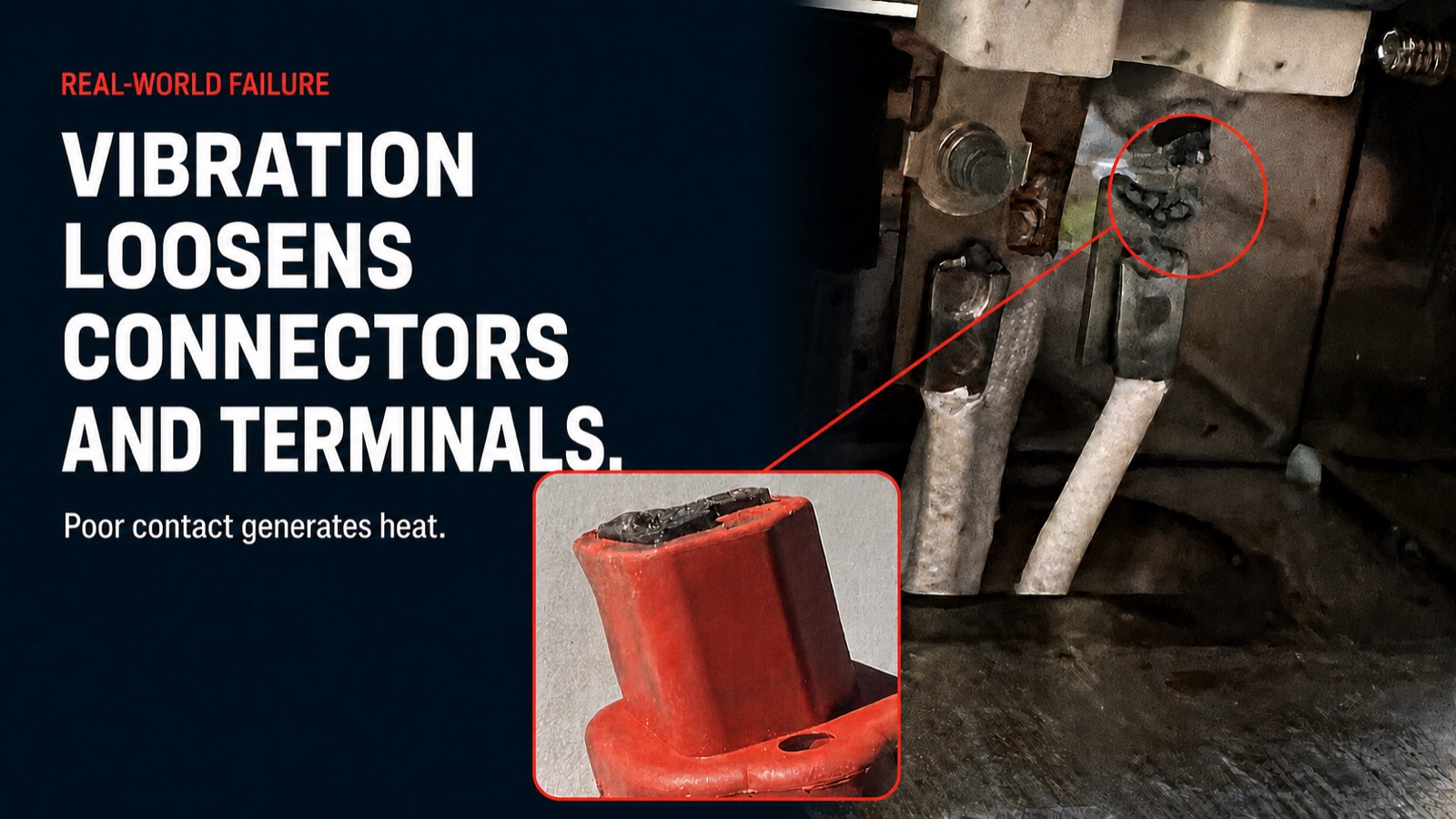
The error pattern from practice
A heating zone fails. The first suspicion is the heating wire. But when you look at the connection, you see something different: one charred, discolored terminal, brittle cables, one contact point with burn marks. The heating element itself is often still intact. The connection failed.
This pattern is repeated wherever heating elements are located on vibrating machines: on the screw barrel heater in injection moulding, on the extruder, on tools, on vibration conveyors and vibrating systems. The vibration does not attack the heating wire, but rather the connection technology – terminal, plug, cable transition.
The trigger is almost always in the connection. If you only replace the heating element, you are replacing the symptom - not the cause.
How vibration loosens connections
A cleanly mounted contact relies on contact force. This force holds two metal surfaces so closely together that the current flows across many small points of contact. Vibration works exactly against this force - through three mechanisms that work together.
The result is always the same: the contact force decreases, the number of live contact points decreases, and the contact resistance increases. A connection that was inconspicuous when new becomes a critical point in the heating zone.
From loose contact to heat
A loose contact is not an isolated fault that simply cuts off power. He becomes the heat source. The reason is the contact resistance at the bad contact point. Voltage drops across this resistance and the power dissipated there increases with the square of the current.
This power is released in a very small area. The terminal locally heats up well above the operating temperature of the heating zone. The heat additionally oxidizes the contact and the resistance increases further self-reinforcing process. The end result is a charred terminal, a connection that is overheated on one side and, in the worst case scenario, a risk of fire on the cable.
A loose contact is indicated by discoloration, smell and local overheating - long before the zone fails completely.
Further vibration damage to the heating element
Loose contact is the most common, but not the only, vibration damage. Continuous vibration puts a strain on the entire chain consisting of elements, cables and sensors.
Wire break at the cable junction
Where the flexible connecting cable meets the rigid element, the bending load is concentrated. Without strain relief, continuous vibration leads to fatigue fractures in the conductor or strand.
Loosening inside the element
If cartridge heaters are poorly compressed, the insulating powder can settle. The heating wire loses grip, heat dissipation becomes uneven and hotspots appear.
Thermocouple and sensor break
Thin thermal wires and resistance sensors are sensitive to vibration. A break in the measuring point produces incorrect values - and the control heats in the wrong direction.
Wandering fortification
If the mechanical fixation of the element is loosened, the thermal contact with the tool or cylinder changes. The zone becomes too hot or too cold even though the setpoint is correct.
Design vibration-proof in six steps
Vibration resistance does not come from a single component, but from the coordinated chain. As a manufacturer with its own production of heating elements, connections and cables, this chain can be designed to be closed.
Name the source of the vibration
Roughly classify the amplitude, frequency and direction of the vibration: injection moulding, extruder, vibrating conveyor or test stand place different loads.
Condense element structure
Choose cartridge heaters with compressed MgO. A tight internal structure leaves no room for the heating wire to move under vibration.
Secure connection type
Secured or crimped contacts instead of loose screw terminals. Wherever screwing is carried out, securing and a defined tightening torque are required.
Relieve the strain on the cable
Mechanically relieve the transition from flexible cable to rigid element: strain relief, kink protection and protected cable routing prevent fatigue fractures.
Fix the element firmly
Backlash-free fastening in the tool or cylinder. A moving seat changes the heat contact and creates control errors.
Set check interval
Check contacts at fixed intervals for tightening torque, discoloration and wiring condition. This way, the loose contact is detected before it chars.
Industries and typical sources of vibration
Vibration is not a special case, but rather everyday life in plastics and metal processing. The design of the heating element follows the installation situation and the vibration load.
| Industry | Typical source of vibration | Affected component | Critical point |
|---|---|---|---|
| injection moulding | Clamping unit, ejector, cylinder drive | Cylinder heater, nozzle heater, tool cartridge | Terminal and cable outlet on the connection head |
| extrusion | Screw, drive, continuous operation | Cylinder heating bands, flange heating | Contact pressure of the band clamps over a long service life |
| Die casting | Closing movement, ejection, core pulls | Tool cartridge heaters, clamping heater | Strain relief for the cable on the moving tool |
| Vibratory conveyor | Unbalance drive, continuous vibration | Channel and container heating | Continuous vibration directly on the element and connection |
| Packaging / FFS | Cycle, sealing movement, shaking sections | Sealing jaw and plate heating | Contact fatigue due to high cycle times |
| Test bench / automotive | Test vibration, engine, unit | cartridge heaters and sensors under construction | Sensor breakage and measurement errors due to vibration |
Maintenance checklist
These points separate the incipient vibration damage from sudden failure. They are suitable for recurring visual inspections of oscillating heating zones.
Visual inspection connection
- Terminal discolored or charred?
- Burn marks or smell at the contact?
- Cable brittle, broken or abrasive?
- Strain relief still tight?
Function and mechanics
- Checked the tightening torque of the terminal?
- Temperature of the zone stable?
- Element fixed without play?
- Sensor value plausible and calm?
A notice: This checklist is a general guide for machine operators and setters to identify possible signs of vibration damage at an early stage. Since we can neither influence nor determine the operating conditions of our products, we cannot guarantee the duration of their durability or the achievement of the desired results. A legal claim cannot be derived from this checklist; The evaluation and testing in individual cases lies with the operator.
Inquire about heating element and connection Tell us the installation situation, performance and connection type – we will advise you on the right heating element and connection design, directly from the manufacturer.
Inquire now