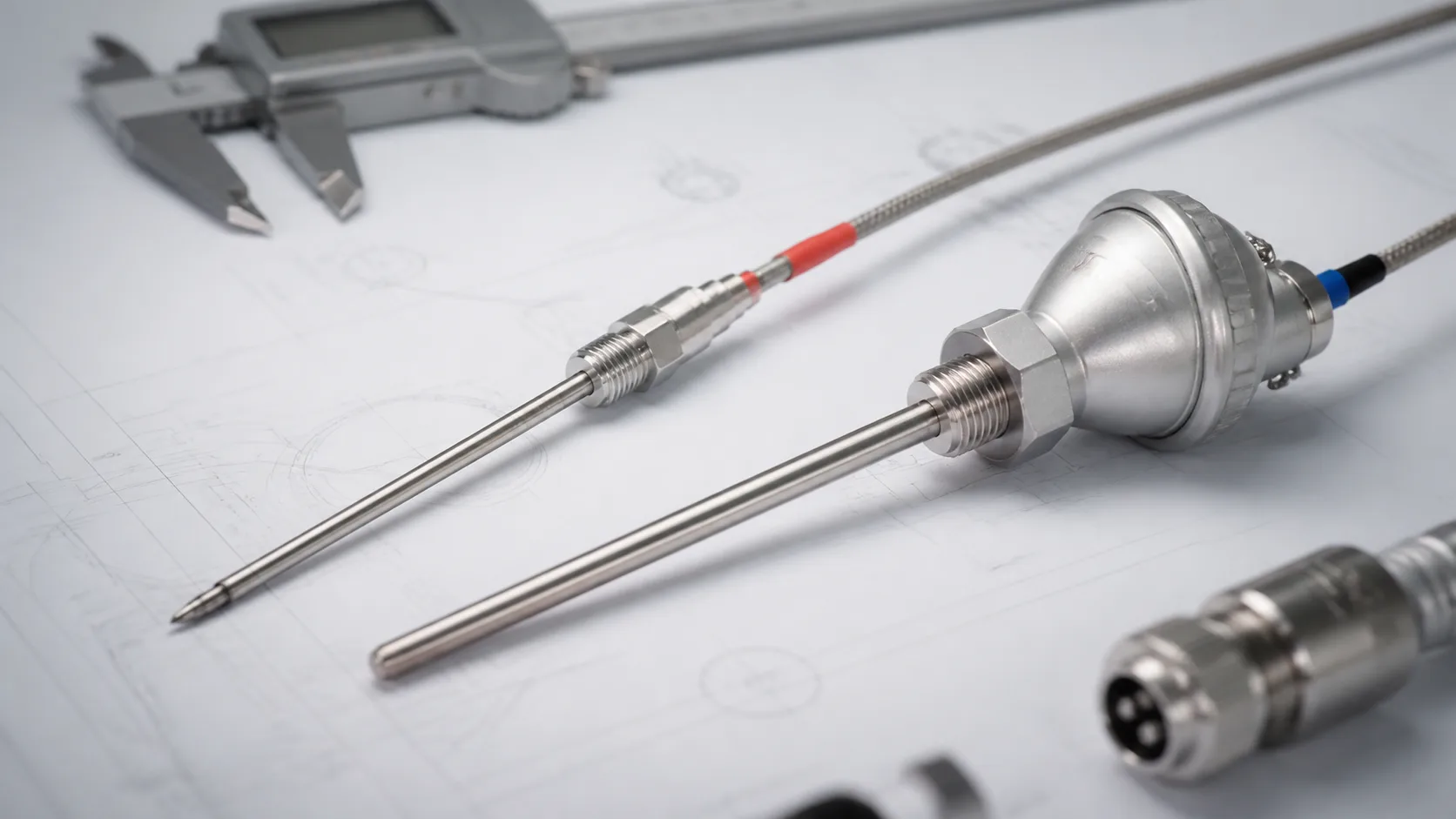
How do the measuring principles differ?
A resistance sensor measures the temperature-dependent change in resistance of platinum. Pt100 and Pt1000 are the common industrial versions. The characteristic curve is standardized, the signal can be easily evaluated and the measurement is very reproducible if the wiring is clean.
A thermocouple works differently: two different metals form a connection at the measuring point. A thermal voltage arises between the measuring point and the connection point. The measuring device must therefore detect the reference junction and compensate for it mathematically.
There is no better sensor. There is only the sensor that better suits the application.
The decision in one sentence
If a process in the low to medium temperature range needs to be monitored as precisely as possible and stable over the long term, a resistance sensor is often the better basis. If heat, rapid temperature changes, small measuring points or strong mechanical stress dominate, a thermocouple is usually more practical.
This rule does not replace interpretation. However, it helps to determine the direction before the design, protective tube, cable, connection head and installation length are defined.
Resistance sensor Pt100/Pt1000
For precise, reproducible measurements in the low and medium temperature range.
- high accuracy
- very good long-term stability
- good reproducibility
- ideal for stable process monitoring
Thermocouple
For high temperatures, fast response and robust mechanical operating conditions.
- very large temperature range
- short response time
- small measuring point possible
- robust in the face of vibration and tight installation space
When is a resistance sensor the better choice?
Pt100 and Pt1000 are used when small temperature deviations become real process information. This applies to test benches, laboratory systems, mechanical engineering, tool temperature control, air and media measurements or processes in which a constant controlled variable is more important than maximum temperature resistance.
For longer cables, the circuit is crucial. A 2-wire circuit can cause measurable errors due to the line resistance. 3-wire and 4-wire circuits significantly reduce this influence and are part of the clean design for more precise measuring tasks.
The measuring current must be taken into account: If it is chosen unfavorably, the measuring element itself can heat up. This effect can be controlled in well-coordinated measuring chains, but should not be ignored in small designs and stationary media.
When is a thermocouple the better choice?
Thermocouples are powerful when the measuring point is small, hot or mechanically demanding. Sheathed thermocouples can be manufactured with small diameters, can be bent and react quickly if the measuring point is close to the process.
Typical areas of application include hot runner technology, plastics processing, furnace systems, exhaust systems, tool and mould making, and high-temperature processes. The last decimal place is often less important, but rather a robust measurement in a difficult environment.
The complete measurement chain is important. Thermocouple type, compensation cable, connection point, measuring device and cold junction compensation must match. A high-quality sensor cannot compensate for incorrect cables or an unfavorable connection point.
What criteria determine the selection?
Typical wrong decisions in practice
The sensor type is often asked first. From a technical point of view, the order is different: first clarify the measurement task, process environment and installation, then determine the sensor type. Otherwise measuring points will appear that look good on the data sheet, but are too sluggish, too sensitive or difficult to replace in operation.
Typical errors are protective tubes that are too massive in fast processes, unsuitable cables in hot areas, a lack of strain relief, immersion depths that are too short or an evaluation that does not match the type of sensor. Especially with special sensors, the design of the entire measuring point is crucial.
A good temperature sensor is not a single component. It is a suitably designed measuring point.
Frequently asked questions about thermocouples and resistance sensors
When is Pt100 useful?
For stable processes with tight tolerances, for laboratory and testing tasks and wherever accuracy and repeatability are of paramount importance.
When is there more to be said for a thermocouple?
If the measuring point is hot, small, dynamic or mechanically loaded. This is particularly true for furnace construction, hot runner technology, tools and high-temperature processes.
What needs to be taken into account when managing?
Depending on the accuracy, Pt100 require a suitable 2, 3 or 4-wire circuit. Thermocouples require suitable cables for thermopairing.
Why is installation so important?
The best type of sensor is of little help if the immersion depth, protective tube, tip or connection do not match the measuring point. The installation determines the real response time and service life.
Can you simply exchange both types of sensors?
No. Measuring principle, evaluation device, wiring and characteristic curve differ. A replacement must be checked electrically and mechanically.
What should be included in a request?
Temperature range, medium, installation situation, desired response time, cable length, connection type and mechanical load are the most important information.
Are you unsure which type of sensor is suitable?
Send us the temperature range, measuring point, installation situation and ambient conditions. We check whether a thermocouple or resistance sensor is the better solution.